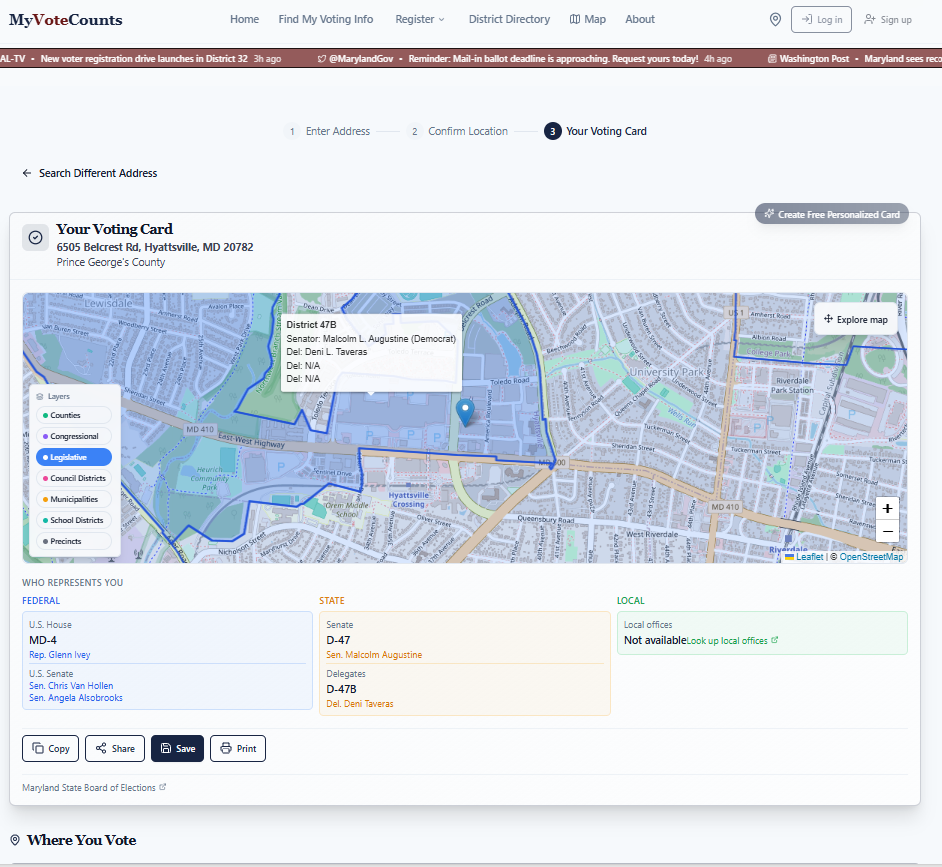
My Voting Card
An address-resolved summary of applicable jurisdictions, representation, election resources, official links, and evidence labels organized into one civic profile.
MyVoteCounts by BallotBox
One address in. One authoritative governance profile out.
MyVoteCounts is a Maryland-first browser experience designed to connect an address with applicable districts, jurisdictions, representatives, election resources, and the official sources behind each result.
Registry availability
The current MyVoteCounts experience remains a private, unpublished, controlled Maryland beta.
Address-to-governance resolution
Civic information is often fragmented across jurisdictions, election authorities, public records, geographic boundaries, and government websites. MyVoteCounts is designed to resolve that complexity into one clear experience without hiding the evidence behind the result.
The experience uses an address to determine applicable civic geography. It is not presented as a person-level voter lookup or source of private voter information.
The system is designed to match the location to applicable districts and jurisdictions using approved geographic and official-source evidence. Missing, malformed, stale, or ambiguous information is not silently converted into a confident answer.
Resolved geography is connected to the public offices, representatives, election authorities, voting resources, and official links that apply to that location.
Each result is designed to carry its source, evidence classification, and relevant verification context so people can understand what the information represents.
Public-product boundary
The public experience is designed to minimize data collection and does not expose raw voter files, person-level contact data, political targeting information, or private campaign data.
Core public experience
The My Voting Card is intended to give a person one understandable place to review the civic geography, representation, election resources, official links, and evidence connected to an address.
Illustrative Maryland civic profile
Maryland · Sample jurisdiction
District information appears only when supported by applicable geographic and official-source evidence.
Office and representative information is designed to appear only when it can be connected to the resolved geography through approved sources.
This controlled beta capture shows how a non-residential Maryland location is resolved into geographic boundaries, applicable public offices, and source-linked civic context.
Public civic experience
An address-resolved summary of applicable jurisdictions, representation, election resources, official links, and evidence labels organized into one civic profile.
A structured view of overlapping civic boundaries designed to help people understand which districts, governments, boards, and public bodies apply to a location.
Direct pathways to authoritative registration, voting, election-calendar, and election-administration information published by the responsible public offices.
Clear information about where a surfaced value came from, how it was classified, and when additional verification, review, or correction may be required.
Public-product boundary
These are public civic-information capabilities. Professional dashboards, campaign operations, political communications, fundraising, targeting, and private organizational workflows belong outside the MyVoteCounts public trust layer.
Geographic resolution
A single Maryland address can exist inside multiple layers of government and election administration. Congressional districts, state legislative districts, counties, municipalities, school or local boards, and election authorities may overlap without sharing the same boundaries.
MyVoteCounts is designed to reconcile those layers conservatively and display only the jurisdictions supported by the available evidence. Uncertain or malformed inputs should produce an explicit limitation, review state, or unavailable result rather than an unsupported civic profile.
Resolution control
Geographic resolution is not treated as verified merely because a system can produce an answer. The answer must be supported by the applicable source and resolution controls.
Evidence taxonomy
A civic-information system should explain what each surfaced value represents. MyVoteCounts uses distinct evidence labels so official records, estimates, derived information, models, and interface demonstrations are not presented as though they carry the same authority.
Taken directly from an authoritative government record with no transformation.
Published by an official body as an estimate or provisional figure.
Computed from one or more cited sources using a documented method.
Produced by an internal model to fill a gap. Always labeled, never authoritative.
Sample content used to demonstrate an interface. Not a factual claim.
Modeled or illustrative information is never presented as an official record.
Fail-closed public trust
MyVoteCounts is designed around the principle that withholding an uncertain answer is more responsible than presenting a convenient answer as fact.
Authoritative public records and responsible election or government sources form the foundation of the public experience.
Missing, ambiguous, malformed, stale, conflicting, or incomplete evidence should be identified rather than concealed.
Civic information changes. The intended assurance model accounts for effective dates, source updates, correction history, and review status.
Candidate information that has not passed applicable source, evidence, and review controls should remain outside the verified public experience.
Automation can support collection, reconciliation, and review, but people remain accountable for publication decisions, corrections, and system behavior.
Product separation
MyVoteCounts is the public civic trust layer. BallotBox Pro is a separate professional environment. Public-user information does not automatically transfer into professional products.
Excluded capabilities
MyVoteCounts is not presented as providing raw voter data, person-level contact records, voter targeting, persuasion, campaign management, donations, fundraising, political communications, candidate scoring, candidate endorsement, or automated candidate approval.
Maryland first
Maryland is the current proving ground for the MyVoteCounts method. The controlled beta is focused on validating address resolution, civic geography, official-source integration, provenance, accessibility, privacy, correction controls, and the public-user experience within one state.
That operating method is intended to support later state-by-state expansion. MyVoteCounts does not currently claim nationwide coverage, nationwide data parity, certified State Packs, or presidential-scale operational readiness.
The current controlled build is a browser experience designed for desktop, tablet, and mobile-browser use. Responsive access is part of the product direction. A native mobile application remains a separate future workstream and is not represented as currently available.
Current availability
MyVoteCounts remains a private, unpublished, controlled Maryland beta focused on verification, quality assurance, accessibility, privacy, and product usability.
Availability
No public launch date is being announced. Public access, beta enrollment, connected submissions, domain activation, and release remain subject to separate approval.
This page does not collect or transmit beta-enrollment information.